
What Changed in Haircare Bottle Decoration Over the Last Five Years
Haircare bottle decoration has changed less in its methods than in its constraints. Screen printing, hot stamping, labels and in-mould labelling all still do the job they did five years ago. What moved is the material the decoration sits on, the design freedom the market allows, and the paperwork that has to accompany the pack. Teams that noticed only the decorative changes are the ones being caught out by the structural ones.
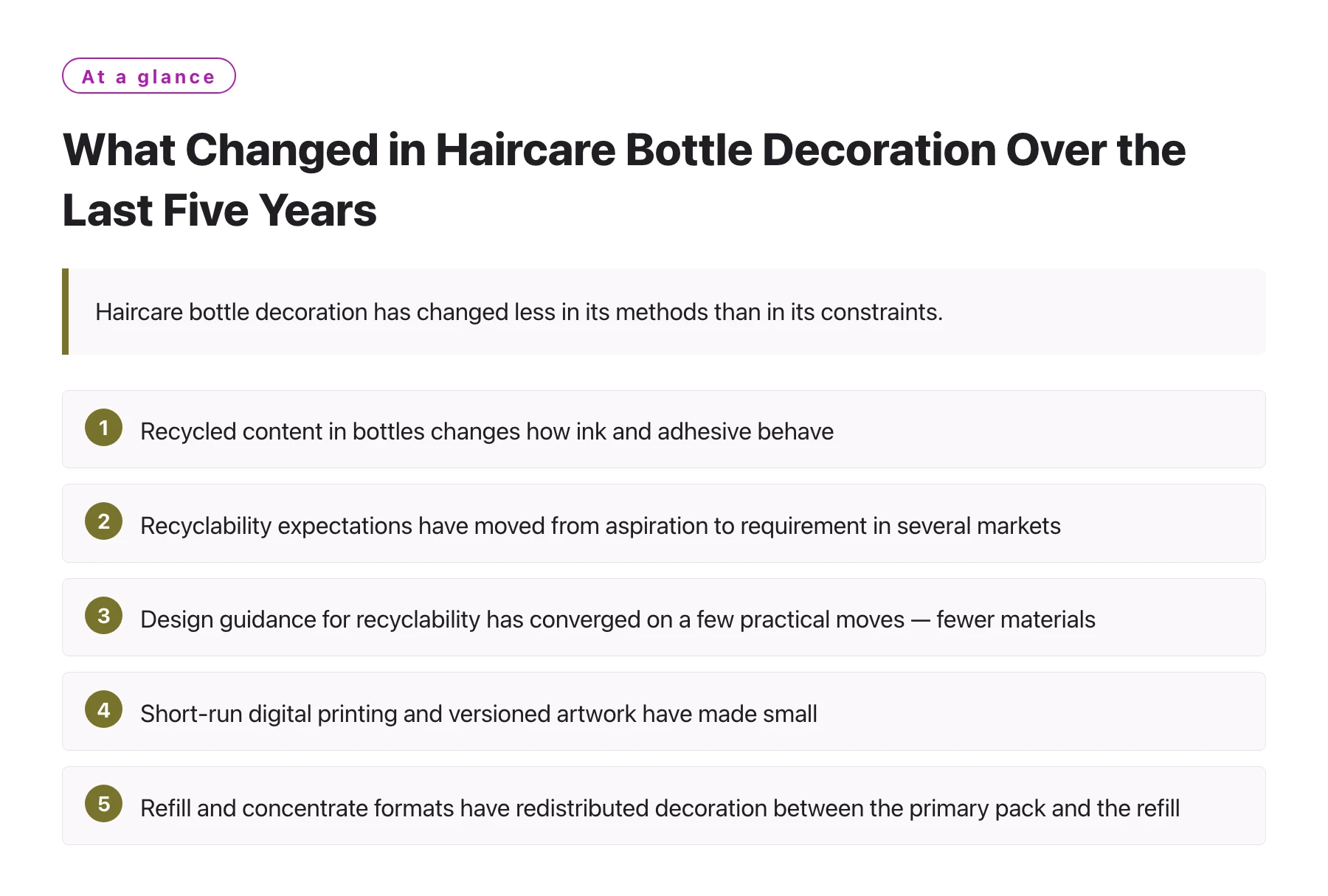
Key takeaways
- Recycled content in bottles changes how ink and adhesive behave, because post-consumer resin is less uniform than virgin material and can vary batch to batch.
- Recyclability expectations have moved from aspiration to requirement in several markets, which makes removability and material separation part of the decoration brief rather than an afterthought [1].
- Design guidance for recyclability has converged on a few practical moves — fewer materials, removable components, lighter packs — and decoration choices are judged against them now [2].
- Short-run digital printing and versioned artwork have made small, market-specific haircare batches viable in a way that screen tooling never allowed.
- Refill and concentrate formats have redistributed decoration between the primary pack and the refill, changing which surface carries the brand.
- Industry-level sustainability commitments have made packaging data something brands are asked to report, not only something they choose [3].
Ask a packaging engineer what changed and you will hear about substrates and process windows. Ask a brand team and you will hear about recycled bottles, refill pouches and market-specific artwork. Both answers are correct, and the interesting part is where they meet: the decoration specification.
Five years is long enough for a haircare line to have been re-specified once, and the second specification usually looks different from the first even when the pack looks the same. The changes below are the ones with practical consequences for anyone writing a decoration brief today.
This is not a trend list. It is a description of the constraints that have moved, with a note on what each one asks of a buyer.
The material shift is the biggest change
Recycled and mono-material resin is now a normal request in haircare, and it changes decoration in ways that are not obvious from a colour chip. Post-consumer resin varies more than virgin material, so the surface can differ slightly from batch to batch, and the same ink or adhesive may perform differently across deliveries. A supplier that tests adhesion per resin batch is describing a process adapted to the shift.
Mono-material packs push in the same direction. When the bottle, closure and label need to move through recycling together, decoration has fewer degrees of freedom: metallised finishes, incompatible sleeve materials and strongly pigmented coatings all become harder to justify. The practical response is to decide the end-of-life route early and let it constrain the design, rather than designing first and testing recyclability afterwards.
Light-weighting, another long-running trend, makes this harder still. Thinner walls flex more in the hand and in the filling hall, so decoration that tolerates a rigid container can crack or scuff on a lighter one.
Regulation moved into the packaging brief
The direction of travel in major markets is towards verifiable recyclability and recycled content requirements attached to packaging, with the detail arriving in stages. For buyers, the practical effect is that decoration decisions now have a compliance dimension: a full-body sleeve, a metallised label or a barrier layer may be acceptable today and questioned later.
That is why packaging data is increasingly requested alongside product data. A supplier who can state the material composition of each component and how the pack is intended to be handled at end of life is easier to work with than one who can only confirm what it looks like.
It also argues for treating the decoration specification as a living document. A requirement introduced mid-life should be a revision to a known document, not a redesign discovered from a customer complaint.
Decoration technology: more flexibility, not more spectacle
The technical changes in decoration have mostly been about speed and changeability. Digital printing makes short runs and versioned artwork economically reasonable, which suits haircare ranges that launch in several markets with different text. Curing systems have moved towards faster processes, which shortens the window between decoration and packing and reduces the risk that units are handled before they are set.
Inspection has changed too. Camera-based inspection during the decoration run is now common enough that the question is less about whether it exists and more about what it is programmed to reject. That answer belongs in the acceptance criteria rather than in a conversation after a delivered batch.
None of this makes the older methods obsolete. Screen printing is still the durable, flexible workhorse for mid-volume haircare, and hot stamping still produces accents that digital output struggles to imitate convincingly. The change is that there are now more viable positions on the cost and volume curve.
What changed, and what it asks of a buyer
| Change | Practical effect on decoration | What to put in the brief |
|---|---|---|
| Recycled content in bottles | Surface consistency varies more between resin batches | Ask for adhesion testing per batch and record the resin source |
| Mono-material design | Fewer compatible decoration options; removal matters | State the intended end-of-life route and the maximum material count |
| Recyclability requirements | Decoration may determine whether a pack can be sold in some markets | Name the destination markets and require a component composition statement |
| Light-weighting | Thinner walls and more flexibility under handling | Add handling and drop tests to the durability protocol |
| Digital and short-run printing | Versioned artwork becomes affordable at small volumes | Plan artwork variants up front instead of overprinting later |
| Automated inspection | Rejects are detected during the run rather than at the end | Agree what the system is programmed to reject and keep the record |
| Refill and concentrate formats | Decoration divides between primary pack and refill | Decide which surface carries the brand and which stays plain |
Almost every row converts into a specification clause, which is the useful way to read a change: it is only real once it is written into a document.
One change that is easy to miss: packaging information is now requested by parties who never asked before. Retailers, distributors and sometimes investors ask for composition and recyclability data alongside product documents, and a brand that cannot produce it quickly looks less prepared than it is. Keep a one-page packaging file per pack — materials, weights, decoration method, intended end-of-life route and the supplier contact — and update it whenever the pack changes. It takes an hour to build and saves a week every time it is needed.
What did not change
The fundamentals are stubborn. A decoration still fails if the substrate and the ink are mismatched. A pilot from production tooling is still the only honest test of a process. A retained sample still settles disputes that memory cannot. Curing still takes the time it takes, whatever the launch date says.
It is worth saying that plainly, because change narratives tend to imply that old disciplines are obsolete. In packaging they are not; they have simply acquired new constraints. The teams that handle change well are usually the ones that were already writing specifications with numbers in them.
If there is a single practical adjustment for the next five years, it is to bring the end-of-life question into the first brief. Not because regulation demands it everywhere yet, but because retrofitting removability or material separation into an existing pack is the expensive way to learn it. Design guidance from industry bodies is freely available and readable within an afternoon [2].
The sourcing side has shifted as well, partly through logistics and partly through how manufacturers present themselves. Buyers now check whether development, decoration and filling sit in one place, because fewer handovers means fewer places for a specification to drift. That is the practical argument behind the scope described as R&D and manufacturing in one place, and it is worth testing on a real project rather than taking on trust.
Experience matters here too. A manufacturer that has been making personal care and fragrance products for decades has lived through at least one packaging transition, and the questions it asks about a brief tend to reflect that. The background published for a Chinese fragrance manufacturer since 1994 is a reasonable indication of how long a partner has been adapting to these shifts.
For ranges sold under someone else's design system, the same changes arrive through the brand owner's brief rather than the manufacturer's. Understanding where decoration decisions sit in that arrangement, described under white label fragrance manufacturing, tells you which constraints you can negotiate and which you have to design within. Whatever the structure, the pack that survives the next few years will be the one whose specification was written with the material, the market and the end of life already in it. The wider scope of work a manufacturer publishes, available at the Xuelei website, is the sort of material to read with these questions already prepared.
Sources
- European Commission: Packaging Waste and the PPWR —— EU rules on packaging and packaging waste, including the Packaging and Packaging Waste Regulation requirements on recyclability and design.
- Sustainable Packaging Coalition —— A membership organisation working on more sustainable packaging design, publishing material and recyclability guidance.
- Cosmetics Europe —— The European trade association for the cosmetics and personal care industry, publishing guidance, positions and market information.
Frequently asked questions
How has recycled resin affected bottle decoration?
Post-consumer resin is less uniform than virgin material, so surface behaviour can vary between batches. That makes per-batch adhesion testing and a clearly recorded resin source more important than they were on virgin material.
Are metallised finishes and full-body sleeves still usable?
They can be, depending on the market and on the pack's intended end-of-life route. The question is no longer only aesthetic; if the decoration prevents material separation or recyclability, it may create a market problem later.
What has digital printing changed for haircare packaging?
Mainly small runs and versioned artwork. Market-specific text and short promotional variants became affordable without cutting a screen for each version, which suits ranges sold in several countries.
Do refill formats change decoration requirements?
Yes. The brand surface is split between the primary pack and the refill, and the primary pack has to survive repeated handling. Decide which components carry the identity and which stay minimal.
What packaging information should a brand keep on file now?
Component materials and weights, decoration method, intended end-of-life route, supplier contacts and any composition statements. Retailers and distributors increasingly ask for it, and having it ready avoids delays.
Free · No spam · Unsubscribe anytime